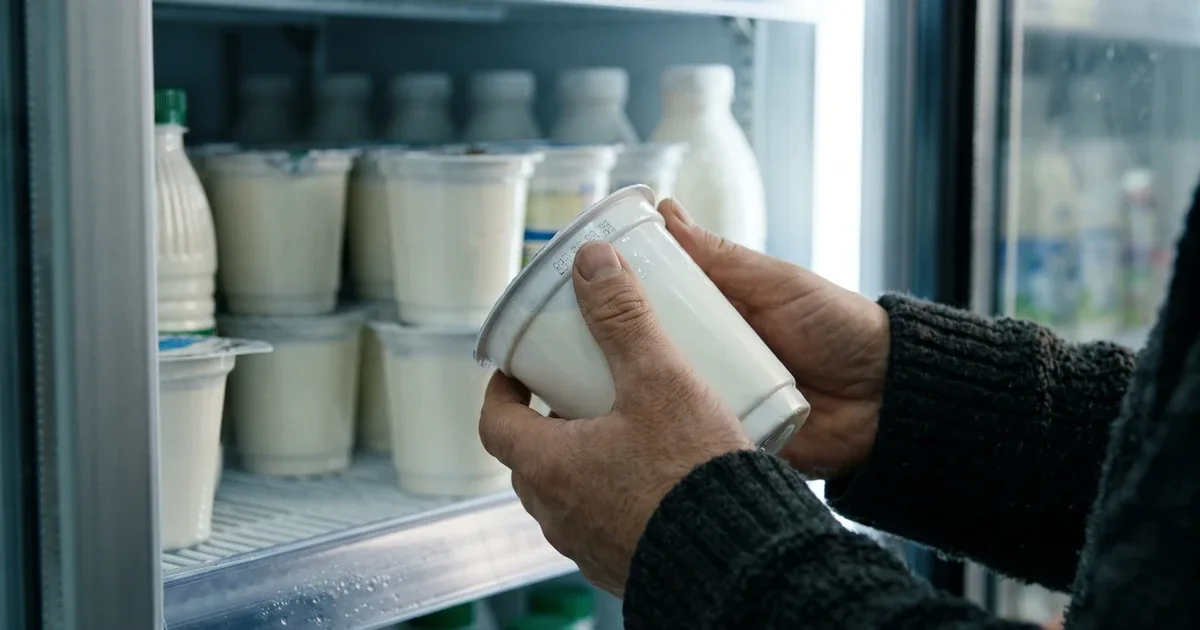
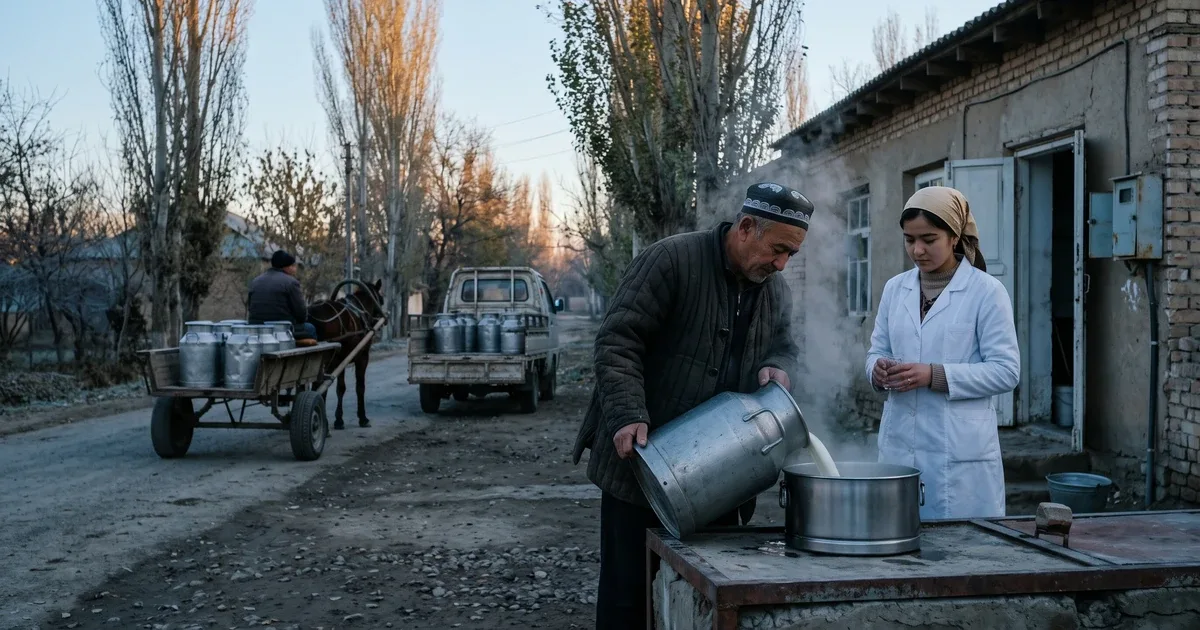
In the morning the plant took in 1,000 litres of milk. In the evening the cottage cheese (tvorog) and yogurt were weighed, and output was noticeably below plan. The technologist says the milk came in thin, the storekeeper says the scales are accurate, and the shift master says everything followed the recipe. Who is right?
A meat line faces the same question. Two carcasses were received, but mince, sausage and boneless meat fell short of the expected weight. Has this happened at your plant?
This article shows the five points where dairy and meat processors lose yield and money. For each one you will see what the system should record and where to start. If you are setting up or acquiring a plant in Uzbekistan, it also explains which local practices your software has to handle.
Where losses hide
Raw material in dairy and meat is "alive". It varies at intake, loses weight during processing and spoils in storage depending on temperature. That is why a simple "stock in, stock out" record does not work here.
Losses usually occur in five places:
- Intake. Volume is recorded, but fat content and quality are not.
- Yield. Actual yield is below the norm, but nobody compares the two.
- Batch. Nobody knows which raw material went into which product.
- Cold storage. Temperature was breached and product spoiled before its date.
- Delivery. Returns and store debts are not tracked separately.
Each point looks small on its own. Together they can eat the plant's entire margin. When a custom system makes sense at all and how it is built is covered in the main guide to custom ERP development. This article covers only what is specific to dairy and meat.
Raw material intake: litres alone are not enough
Accepting milk by volume only is the most common mistake. A thousand litres of rich milk and a thousand litres of thin milk do not give the same amount of curd. Fat content is the share of fat in milk, measured in percent. The yield of cottage cheese, sour cream and butter depends largely on fat and protein.
Also read Did Your Machine Stop Without Warning Again? Running Planned Equipment Maintenance in an ERPEvery intake should record:
- Quantity. Litres or kilograms, from a scale or flow meter.
- Fat and protein. From the lab or a milk analyser.
- Acidity. It shows freshness. High-acidity milk may curdle.
- Temperature. How well the milk was chilled on arrival.
- Supplier and time. Which farmer or collection point.
In Uzbekistan most milk comes from small household (dehkan) farms and village collection points rather than large dairy farms, so dozens of suppliers delivering milk of different quality in one day is normal. Many plants pay farmers according to fat content. If the system calculates payment in fat units, the argument about "thin milk" disappears. Farmer and plant look at the same number.
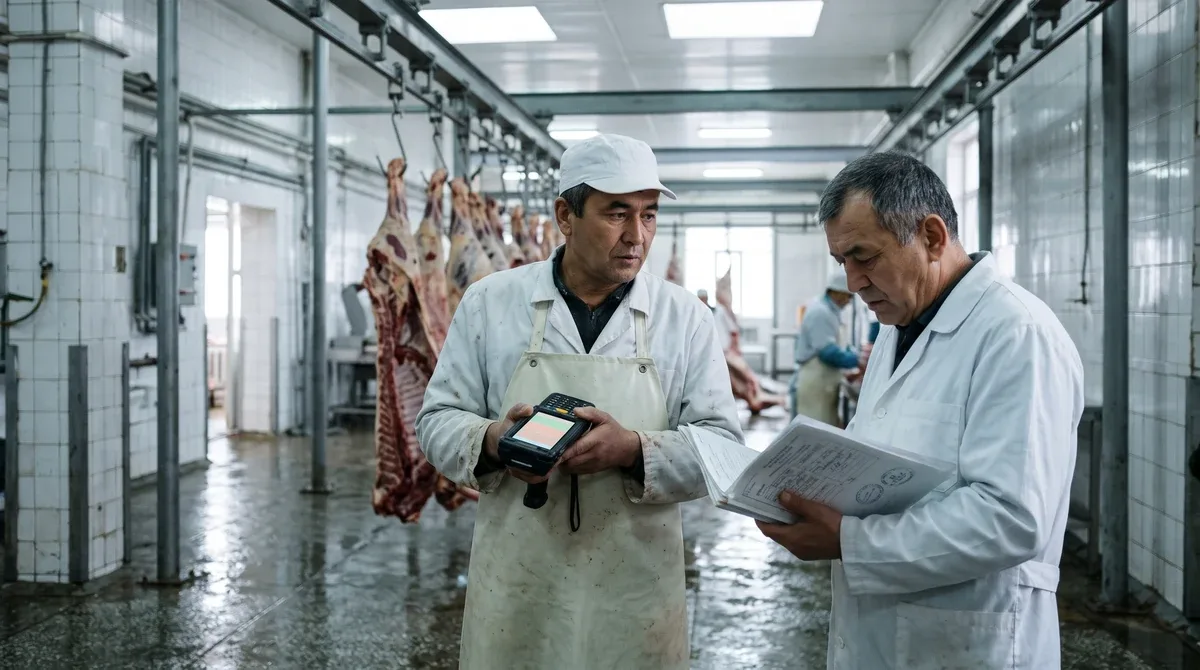
Meat intake works differently. Live animals, half-carcasses or quarters are weighed. Each carcass gets a number and is linked to its veterinary document (a certificate or health statement). Raw material without a document should never move to "accepted" status. The general approach to incoming inspection is covered in the article on quality control in ERP.
Yield: norm versus actual
Yield is the share of finished product obtained from raw material. If 100 kg of meat gives 80 kg of mince, yield is 80%. In dairy it is often tracked as "litres of milk per kilogram of product".
In a dairy plant the norm sits in the recipe. But milk differs every day, so the norm has to be recalculated for the fat and protein of the incoming milk. Separation produces cream and skimmed milk, and both must be booked as separate products. Otherwise the cream looks "lost".
In meat, one carcass becomes dozens of items: boneless meat, bone-in cuts, trim for mince, fat, bone and waste. This is called cutting or boning. According to Penn State Extension in the United States, most cattle have an average dressing percentage of about 63%: the carcass weighs around 63% of the live animal. For dairy breeds the figure is roughly 56–60% or lower. These are US figures, and local cattle may differ. The conclusion holds either way: when you buy animals by live weight, the meat you actually receive varies noticeably with breed and condition.
A hypothetical cutting example. These figures are not a technical norm; they only illustrate the logic:
- Boneless meat — Norm, %: 62; Actual, %: 58
- Bone — Norm, %: 22; Actual, %: 24
- Fat and sinew — Norm, %: 12; Actual, %: 12
- Loss — Norm, %: 4; Actual, %: 6
Actual yield is 4 points below the norm. The cause may be the animal's condition, the boner's skill or meat that leaves the line unweighed. If the system records every cutting session by boner and carcass, the cause becomes visible within a week. Multi-level recipes and semi-finished goods are explained in detail in the article on ERP for manufacturing.
Batches and cold room temperature
A batch is a group of products made from the same raw material at the same time. Each batch gets a number, date, shift and raw material source. When a complaint comes in, you can find within minutes which farmer's milk went into which yogurt.
The second condition for milk and meat is the cold chain. It means the product is kept at the set temperature without interruption from intake to the customer. Even one break shortens the real shelf life, while the date on the label stays the same.
Cold storage needs three things in the system:
- Temperature log. For each chamber, ideally recorded automatically by a sensor.
- Limits and alerts. If temperature leaves the range, the responsible person is notified at once.
- Link to batches. You can see which batches were in that chamber at that moment.
Set the exact temperature range with your technologist and local sanitary requirements. Which batch ships first, how to set expiry alerts and how to write off expired stock is covered in the article on batch and expiry date tracking.

Delivery, returns and store credit
Dairy and meat products are often delivered to shops in the plant's own vans. Three problems arise here.
The first is the route. Yogurt and sausage should not travel long in the heat. In the evening the system turns orders into tomorrow's loading sheet, sequences the shops along the route and shows what to load in which order.
The second is returns. When a driver brings fresh product, he takes back items close to their date. Each return is recorded as a separate document by store, product and reason. That shows which stores are being oversupplied.
The third is credit. In Uzbekistan many small shops take goods on credit and pay on the next visit. A hypothetical situation: a driver visits 40 shops a day and half of them pay only in part. After a month, nobody can say from a notebook exactly how much each shop owes. In the system each store has a credit limit and a payment term. When the limit is exceeded, the driver app warns before the next delivery. What to do about unpaid balances is covered in the article on collecting overdue debts.
Cost: how yield turns into money
A hypothetical example in volumes only, without prices. The plan was 150 kg of cottage cheese from 1,000 litres of milk. Actual output was 135 kg.
By plan, 1 kg of cottage cheese needs 1,000 / 150 ≈ 6.7 litres of milk. In fact it needed 1,000 / 135 ≈ 7.4 litres. Each kilogram took about 11% more milk. Since milk is the largest cost item, the product cost rises by almost as much.
If the selling price was set from planned cost, that gap comes straight out of profit. When the system shows planned and actual yield side by side for every batch, management does not have to wait for month-end.
In meat, costing is harder still. Products from one carcass have different prices: boneless meat is expensive, bone is cheap. How to split carcass cost across parts, by weight or by sales value, should be agreed once with your accountant and fixed in the system.
Off-the-shelf software or custom development
Both paths have their place. Off-the-shelf software goes live faster and has been tested at many plants. Its strength is standard inventory, sales and accounting.
Custom development is usually considered in three cases. When farmers are paid for milk in fat units. When meat cutting follows your own scheme with tracking by boner. When the driver app, credit limits and returns must work as one process.
Before choosing, write your process down: every step from intake to the shop, who records what and which figure is needed. Then check each option against that list.
Where to start: a checklist
- List the milk or meat received and the product output for the last two weeks.
- Confirm the yield norm for each main product with your technologist.
- Make fat content, acidity and the veterinary document mandatory fields at intake.
- Number every batch and link it to its raw material source.
- Introduce a temperature log for each cold room, with sensors if possible.
- Move returns to a separate document by store, product and reason.
- Set a credit limit and payment term for every store.
- After a month, compare planned and actual yield by batch.
You do not have to roll everything out in one day. Starting with intake and yield usually brings the fastest result.
The takeaway
In dairy and meat processing, losses do not hide in one big place but in five small points: intake, yield, batches, cold storage and delivery. Once the right figure is recorded at each point, the "thin milk" argument becomes a conversation based on facts. Take the first step today: put intake and output for the last two weeks side by side and see where the gap is largest.
Frequently asked questions
Does a small dairy plant need an ERP?
With one or two products and your own shop, an intake log and a simple spreadsheet may be enough. A system pays off once milk comes from several suppliers, the range grows and you start supplying stores on credit. At that point manual records stop showing both yield and receivables.
Where should yield norms come from?
The starting figure comes from the technologist's recipe. It is then checked with control batches: raw material is weighed, fat content is recorded and finished product is weighed. After several batches the norm is adjusted to reality. In milk it depends on fat and protein, in meat on breed and body condition.
Is a handwritten cold room temperature log enough?
A handwritten log is still a log, but it only shows the moment someone wrote it down. If a door stays open overnight or a compressor stops, nobody knows until morning. A sensor with an automatic log records continuously and sends an alert when limits are breached. Confirm the required range with your technologist and local sanitary rules.
Off-the-shelf software or custom development?
If your processes are close to standard, off-the-shelf software goes live faster. If milk is paid by fat units, carcass cutting follows your own scheme, and the driver app, store credit and returns are specific to you, a packaged product will need heavy adaptation. Compare both options against a written list of your own processes.
Shall we find where your yield goes?
We will look at how intake, yield norms, cold storage and store deliveries are handled today and suggest which part is worth automating first.