


Short answer: fashion jewelry sells well on Uzbek marketplaces: it is light, affordable and a popular gift. But money leaks in three places in this category. First, poor photos of shiny items. Second, logistics that land on a cheap product. Third, swapped items on returns. Buyers are not choosing a pair of earrings so much as a style, which is why a brand starts paying off faster in accessories than in most categories.
This article is part of the guide to building your own brand on marketplaces. That guide covers naming, packaging and positioning in general; this one covers only what is specific to accessories and fashion jewelry, for a foreign brand or distributor entering a market where Uzum Market, Wildberries and Yandex Market are the main channels.
The category: fashion jewelry, accessories and fine jewelry
To the buyer it is all "jewelry". To the seller these are three different businesses with different rules:
- Fashion jewelry — Examples: earrings, bracelets, necklaces in alloy, steel, acrylic; Main risk: plating wears off, allergy complaints, low price
- Accessories — Examples: hair clips, belts, sunglasses, bag chains, key rings; Main risk: size, colour, many variants
- Fine jewelry — Examples: silver and gold pieces; Main risk: assay hallmark, high price, swap risk
Most sellers start with fashion jewelry and accessories: entry is cheap and the range turns over quickly. Do not move into fine jewelry until documents and the returns process are sorted.
Precious metals: the hallmark and the words in your listing
Under the regulation on the State Assay Office under the Ministry of Finance of Uzbekistan, the office assays jewelry made of precious metals before sale and marks it with the state assay hallmark. The hallmark is applied only if the item meets the declared fineness. The office also inspects businesses that sell jewelry.
Also read Selling on Amazon from Uzbekistan: who can be the seller, and what it takes to reach a first profitIn practice this gives three rules:
- "Silver" and "gold" only for hallmarked items. A silver-plated alloy is "silver-tone plating", not silver. If your pieces already carry a hallmark from another country, check with the Assay Office how imported items are handled before you ship.
- Fineness and weight in the listing. For a hallmarked piece, state fineness, weight and stone type. Buyers compare on exactly these parameters.
- Platform rules on top. The platform may ask for extra documents to enter the jewelry category. Read the requirements in the seller account and get a written answer from your account manager.
This is not legal advice. Rules change; check the official source before your first shipment.
Photos: how to shoot small, shiny items
In jewelry, the photo is half the sale. The buyer cannot hold the item, only look at it. A shiny surface is the hardest subject for a phone camera: it reflects everything, blows out highlights and turns small details into blur.
You can get a good shot even without a studio:
- Soft light. Not direct sun but diffused window light. Cover the window with tracing paper or a white sheer curtain.
- Control reflections. Place white cards around the item. The metal should reflect a clean white strip, not the room, the phone and your hand.
- Macro and focus. Put the phone on a tripod, switch to macro and set focus manually on the stone or clasp. Handheld macro is almost always blurred.
- Scale reference. In one frame, show the item next to a hand, an ear or an ordinary coin-sized object. "Smaller than I expected" is one of the most common reasons jewelry gets returned.
- On a model. Earrings in the ear, necklace on the neck, bracelet on the wrist. This frame shows buyers how the item will look on them.
- Details and clasp. Show the fastening, clasp and back in a separate frame.
Do not shift colours in retouching: if gold comes out yellower or silver whiter than in life, returns follow. Slide order and platform requirements are covered in detail in photos and infographics for marketplace listings.

The listing: material, size and claims
Jewelry buyers expect clear answers to a few questions:
- Material and plating. Not "metal" but specifics: stainless steel, brass, plating type. Use the wording from the supplier's specification.
- Size in millimetres. Earring length, hoop diameter, chain length and clasp type. Give ring sizes in a chart.
- Weight. "Lightweight" is a strong selling point for large earrings, but state the weight in grams.
- Care. How water, perfume and lotion affect the plating. One short line heads off part of future complaints.
"Hypoallergenic" and "nickel-free" only with a document. Ask the supplier for a material specification or a laboratory report. No document, no medical promise: describe the material precisely instead. One negative review about allergies stays on a listing for a long time.
Price segments and sets
Fashion jewelry has three price segments, each with its own economics:
- Cheap impulse buys. Simple earrings, hair accessories. Buyers decide fast, but per-order logistics and commission eat the margin.
- Mid-range. Designer sets, steel pieces, gift boxes. Here photos, packaging and reviews justify the price.
- Gift and premium. Hallmarked silver, pieces with stones. Prices are high, but buyers look hard at packaging and warranty.
Illustrative example. Earrings sell for 25,000 soum, logistics is 6,000 soum per order, commission at 20% of the price is 5,000 soum. With a cost price of 9,000 soum, 5,000 soum is left even before returns. If the same earrings plus a necklace and a bracelet sell in a gift box for 89,000 soum, logistics is still charged on one order and its share drops sharply. The figures are illustrative; use the current tariffs and commission from your seller account.
So do not leave cheap items on their own:
- Sets. Earrings plus necklace, three rings in one style, hair clips in several colours. Set unit economics are covered in bundles and sets on marketplaces.
- Gift box. A consistent, clean box in your brand style moves an item into the gift segment.
- Price floor. Before any promotion, calculate the minimum price for each position. Price corridors and discount rules are covered in marketplace pricing strategy.
Small-item logistics: packing, weight and volume
Jewelry is light, but that does not make logistics free. Platforms charge logistics per order or per unit, and even a small item has a minimum fee. What matters is not weight but the number of items per order.
Packing rules:
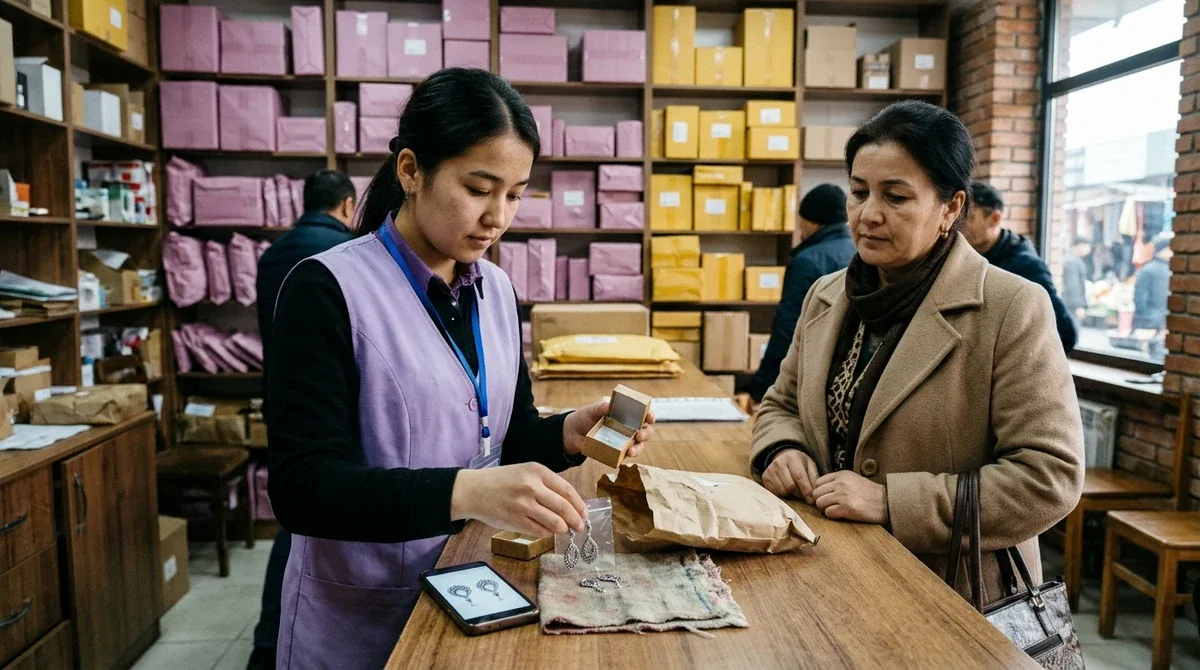
- Not just a zip bag. Earrings in a thin bag can get lost at sorting, crushed or end up in someone else's order. Fix the item to a card, then put it in a bag or a small rigid box.
- Barcode on the outer packaging. On a small bag the barcode folds and will not scan. Stick the label on a flat surface.
- Keep chains from tangling. Fix each chain to a card by its clasp. A tangled chain is a ready-made return.
- Tamper sticker. Seal the box with a numbered or void sticker. You will need it on returns.
- Accurate dimensions. Size and weight in the listing must match the package, or logistics may be recalculated.
Returns: swaps and theft
Jewelry has two kinds of returns. The first is ordinary: wrong size, wrong colour, smaller than expected. Good photos and exact measurements reduce it. The second is riskier: what comes back is not your item but a cheap copy or a worn piece.
How to protect yourself:
- Evidence before shipping. Record packing of higher-value items on video or photograph each piece close up.
- A distinguishing mark. A branded insert card, a small tag on the clasp, recognisable packaging. You will spot a swap at once.
- Check on intake. Open every returned package and compare it with your photos. If the seal is broken, record it immediately.
- Claim deadline. If you find a swap, write to platform support with the evidence. Know the deadline from the seller rules in advance.
Return rules for hygiene-sensitive items such as earrings may differ by platform and category. Read them before you create the listing.
Seasonality: 14 February, 8 March and New Year
Jewelry sales rise around gift dates. The strongest periods are the run-up to New Year, 14 February and 8 March, which is International Women's Day and a public holiday in Uzbekistan. The autumn wedding season and major platform sales add extra demand.
Plan each season backwards from the date:
- Six weeks ahead. Range, gift sets and boxes are ready; goods are on the way to the warehouse.
- Three to four weeks ahead. Goods are in the warehouse, listings and gift photos are updated, internal ads are on.
- One week before the holiday. Peak demand. Check stock daily: if a fast seller runs out, the order goes to another seller.
- After the holiday. Adapt leftover gift sets to the next date and clear the rest at a discount.
A general plan for Uzbek holidays and dates is in the seasonal marketing calendar.
Common mistakes
- Calling a plated item "silver" or "gold".
- Promising "hypoallergenic" without a document.
- A listing with no measurements and no on-model photo.
- Selling cheap items one by one and losing money after logistics.
- Shipping chains loose in a thin bag.
- Putting returned items back on sale without checking them.
- Shipping holiday stock to the warehouse in the week of the holiday.
Checklist before shipping a jewelry batch
- ☐ Each position is classified: fashion jewelry, accessory or fine jewelry.
- ☐ Precious-metal pieces are hallmarked; listings show fineness and weight.
- ☐ Material, plating and size in millimetres are stated.
- ☐ "Hypoallergenic" or "nickel-free" only with a document.
- ☐ The listing has a macro shot, a scale reference and an on-model photo.
- ☐ Logistics share per unit and minimum price are calculated for each position.
- ☐ Cheap items are sold in sets or with a gift box.
- ☐ Items are fixed to cards, barcodes are flat, boxes are sealed.
- ☐ Packing video or photos of higher-value items are kept.
- ☐ The delivery date for the next holiday is calculated backwards from that holiday.
First step: today, take your three best-selling positions and calculate the logistics share per unit for each.
Frequently asked questions
What is required to sell silver or gold jewelry on Uzbek marketplaces?
Under the regulation on the State Assay Office under the Ministry of Finance, jewelry made of precious metals is assayed and marked with the state assay hallmark before sale. Do not call an unhallmarked item "silver" or "gold" in the listing. Check the platform's additional requirements for this category in the seller account.
Can I write "hypoallergenic" in the listing?
Only if you have a document to back it up: a material specification from the supplier or a laboratory report. Without one, state the material precisely, for example "stainless steel, gold-tone plating", and make no medical promises. An allergy complaint stays in the reviews for a long time.
Is it profitable to sell cheap earrings one by one?
Usually not. Logistics and commission are charged per order, and on a cheap item they take a large share of the price. Calculate unit economics for one piece first. If no profit is left, add the item to a set or move it into a higher segment with a gift box.
What should a seller do if a returned item has been swapped?
Before shipping, photograph each item close up or record the packing on video, and seal the box with a numbered tamper sticker. If the item that comes back is not yours, contact platform support right away with this evidence. Check the deadline for claims in the seller rules.
Want to see where margin leaks in your jewelry store?
Let's review your price segments, sets, packaging and return rate together, then agree on which positions to push.


