


Short answer: a customer question is a signal from the person closest to buying. Answer it quickly, accurately and within platform rules, and it becomes an order. Answer late, and the buyer moves to the next listing. The system has three parts: a response time standard, a template library and the habit of moving recurring questions into the listing itself.
Questions and chat are part of a store's daily routine. The overall rhythm is covered in running a marketplace store as an operating system. This article deals only with questions and chat. Replying to reviews is a separate topic, covered in managing marketplace reviews and ratings.
For a foreign brand, this is often the first real contact with local buyers. They write in Uzbek or Russian, in Latin or Cyrillic script, and expect a reply in kind.
Listing Q&A vs chat: what is the difference
Both look like "the buyer wrote, the seller replied", but the jobs differ.
- Who sees it — Question on the listing: Everyone who opens the listing; Chat: Only the buyer who wrote
- Life of the answer — Question on the listing: Months; other buyers read it; Chat: One conversation
- When buyers write — Question on the listing: Usually before buying; Chat: Before and after the order
- Main risk — Question on the listing: An unanswered question is visible to all; Chat: A late reply costs the order
An answer on the listing is written for hundreds of future buyers, so it must be complete, error-free and calm. In chat, speed comes first: the buyer is holding the phone right now.
What buyers ask: six types of questions
List a month of questions and sort them by type, and these groups usually appear:
Also read Selling on Amazon from Uzbekistan: who can be the seller, and what it takes to reach a first profit- Size and fit. "I'm 175 cm, which size?", "Will this filter fit my car?"
- Materials and quality. "Cotton or synthetic?", "Does it smell when heated?"
- What's in the box. "Does it come with a lid?", "Is the charger included?"
- Delivery and timing. "Will it reach Samarkand tomorrow?"
- Warranty and returns. "What if it breaks?", "Can I return it if it doesn't fit?"
- After-order questions. "Where is my order?", "Can I change the colour?"
The first three groups point to listing gaps: if buyers keep asking the same thing about one product, the answer is missing or hard to find. The fourth and fifth are governed by platform rules: do not promise anything on your own, just explain the platform's terms. The sixth is about service quality and needs a fast chat reply.

Platform rules: what the official sources say
The table below is based on official seller help centers. Wildberries and Ozon help materials are written mainly for the Russian seller account. If you sell in Uzbekistan through these platforms, features and terms in your account may differ, so check your own account.
- Uzum Market — Questions: The manual describes buyers asking any product question directly to the seller in chat. Check your seller account to see whether listings have a separate Q&A block.; Chat: Sellers read chats in the buyer app, logged in with their seller account credentials, under "Profile → My chats". The manual advises replying right away.; Deadlines and restrictions: Information a buyer requests must, by law, be given "within a reasonably short period, but no more than three days". Mass messaging and spam in chats are prohibited and can lead to the account being blocked.
- Yandex Market — Questions: The seller account has a "Products → Questions" page. Seller answers appear on the listing with a verification mark.; Chat: Pre-sale chat is started only by the buyer, once the seller turns on buyer messages in the account. FBS and Express order chats are started only by the seller; on DBS, either side can start.; Deadlines and restrictions: Recommended reply time is 1–3 hours, one working day at most. Sharing your contacts, asking for the buyer's personal data, inviting buyers to other messengers and offering discounts in your own store or on other marketplaces are prohibited.
- Wildberries — Questions: The help center has a separate guide on buyer questions in its "Communication with buyers" section.; Chat: The same section has a chat guide.; Deadlines and restrictions: Check deadlines and restrictions in the seller.wildberries.ru help center.
- Ozon — Questions: Questions are answered by official representatives and by buyers who purchased the product. Questions and answers are moderated; off-topic, abusive or promotional content is rejected.; Chat: Check the seller chat terms in the docs.ozon.ru help section.; Deadlines and restrictions: The Q&A help page states no deadline. Set your own internal standard.
Rules change, so review account notifications and help pages monthly.
Response time standard and who answers
Without a written standard, questions get answered "when there's time", and there is none on the busiest days.
A suggested internal standard:
- Chat before the order — Working hours: within 15 minutes; Outside working hours: first hour of the next day
- Chat after the order — Working hours: within 1 hour; Outside working hours: first hour of the next day
- Question on the listing — Working hours: within one working day; Outside working hours: within one working day
- Complaint or dispute — Working hours: first reply in 1 hour, resolution in 24 hours; Outside working hours: first hour of the next day
Fifteen minutes for pre-sale chats is close to Uzum's "reply right away" advice and tighter than Yandex Market's 1–3 hours. The three-day legal limit is a last-resort ceiling, not something to plan around.
Who answers. Three simple rules:
- One named owner per shift. "Whoever is free" ends with nobody replying.
- The owner knows the product. If answering means walking to the shelf and checking the item, this person should sit close to the stock.
- Exceptions on price, discounts and returns are decided by the manager, not the owner. Who handles these requests is written down in advance.
If your head office runs support from abroad, staff the chat on Tashkent time (UTC+5), not head-office hours. General service rules, scripts and quality control are covered in customer service standards; marketplace chat is part of the same standard.
Reply formula and templates
A good reply has four parts: greeting, direct answer, proof, next step.
Hello, Dilnoza! Yes, the kettle comes with a lid. The lid is stainless steel, with a silicone ring on the base. A close-up of the base is now the fifth photo on the listing. If you have more questions, write here.
Answer the question with the first word: "yes", "no", "size M". Buyers do not read long text; they read the first line.
Template library. Prepare one structure for each question type:
- Size — Template structure: Exact size + product measurements in centimetres + advice such as "if you are between sizes, take the larger one"
- Materials — Template structure: Composition in percent + care instructions + photo of the label
- What's in the box — Template structure: List + separately, what is not included
- Delivery — Template structure: Where to see the delivery date on the platform. Do not promise a specific date yourself
- Returns — Template structure: Point to the platform's return procedure. Do not change the terms
- After the order — Template structure: Status check + a concrete next step + timeframe
Replying with photos and video. For "show me the base" or "how is it stitched?", a photo or short video beats text. Whether you can send files, and which links are allowed, depends on the platform. Yandex Market, for example, lets sellers send photos and videos in chat but allows links only to the manufacturer, a service center, an official distributor or your own Market listings.
What not to write: phone numbers, Telegram, external websites. Discounts outside the platform. Requests to leave only positive ratings. Arguments and blame.
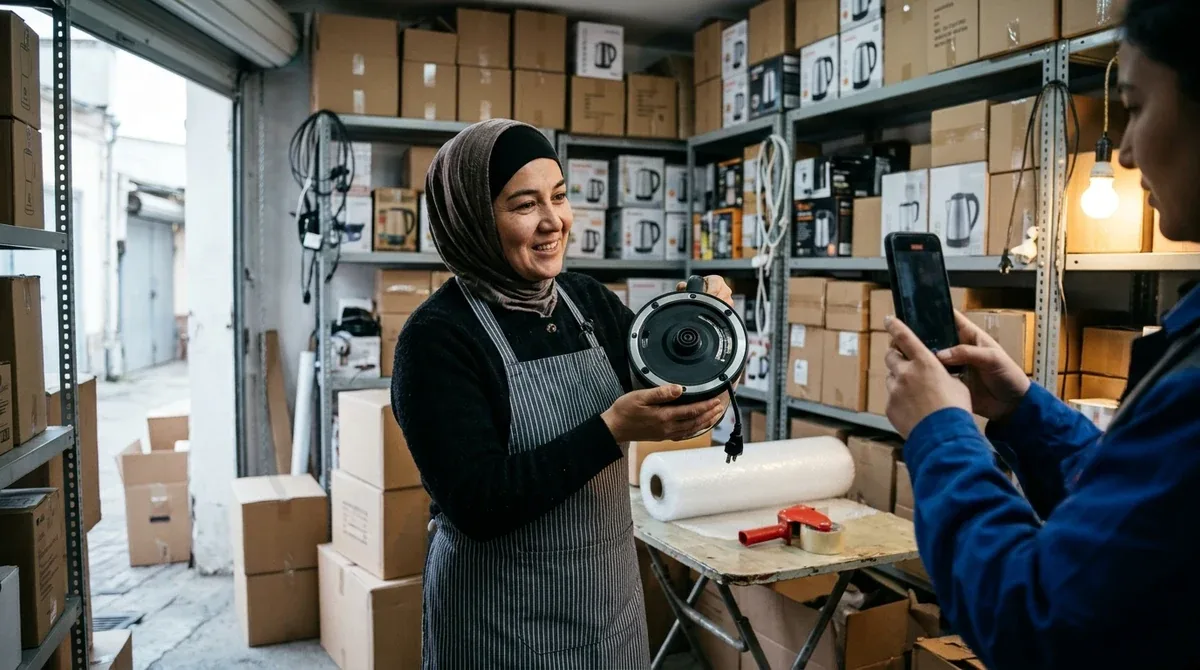
From question to listing: closing recurring questions
Every recurring question is a gap in the listing. Set aside half an hour a week and work through these steps:
- Put all of the week's questions into one table: SKU, question type, text.
- Sort by SKU. If the same question about one product came in more than three times, open a task.
- Decide where the answer goes on the listing: title, first line of the description, attributes or images.
- Record the change date. Two weeks later, check whether that question has become less frequent.
For example, if buyers keep asking about a jacket's sleeve length, add it to the size chart and make a separate slide showing the measurement. Listing rules are covered in building a product listing that sells.
Questions are also the cheapest tool for reducing returns. Returns marked "wrong size" or "not as pictured" often started as a question. Put the question table next to your return reasons and the link becomes obvious. That analysis is covered in managing marketplace returns.
Impact on sales: how to measure it yourself
Uzum's manual says a reply within the first 3 minutes gives 80% conversion to purchase. That is a platform-wide estimate; your category and prices will produce a different number, so measure it in your own store: for one month, record the reply time for every pre-sale chat and whether an order followed.
An illustrative calculation. The store gets 60 pre-sale chats a month. Assume one in three buyers answered within an hour places an order, and one in ten of those answered the next day. Answer all 60 quickly and you get 20 orders; answer all of them the next day and you get 6. The difference is 14 orders. If average net profit per order is 25,000 UZS, fast replies are worth 350,000 UZS of extra profit a month. Your rates will differ; the method stays the same: two groups by reply time and their conversion.
Four metrics are enough to track:
- average first reply time;
- unanswered questions at the end of the day;
- share of pre-sale chats that turn into orders;
- the three most frequent questions and whether the listing now answers them.
Daily checklist
- ☐ Morning check of unanswered questions and chats on every platform.
- ☐ During working hours, first reply within 15 minutes for pre-sale chats and within one hour after the order.
- ☐ Listing questions closed within one working day.
- ☐ No contacts, external links or off-platform promises in replies.
- ☐ Exception requests passed to the manager.
- ☐ Recurring questions added to the weekly table.
- ☐ No unanswered messages at the end of the day, or the reason is recorded.
Summary
A customer question is free information: it shows what the listing is missing, which product is at risk of returns and where service is slowing down. A written response standard, one owner per shift and a template library close questions quickly. A weekly review reduces tomorrow's questions. When both jobs run together, chat stops being a time drain and becomes a channel that grows sales.
Frequently asked questions
How quickly should a seller answer a customer question?
Uzum's seller manual advises replying to chats right away, ideally within the first few minutes. Yandex Market's seller help recommends 1–3 hours, one working day at most. Under consumer protection law, information a buyer requests must be provided within three days, but that is the outer limit, not a working target. A practical internal standard: 15 minutes for pre-sale chats during working hours and one working day for questions on the listing.
Can I give a buyer my phone number or Telegram in the chat?
No. Yandex Market's rules prohibit sharing your contact details, asking for the buyer's phone number or other personal data, inviting them to other messengers and offering discounts in your own store or on other marketplaces. Violations can lead to the store being disabled. Uzum bans mass messaging and spam in chats. Check the exact rules of other platforms in their help centers.
Who on the team should answer questions?
Someone who knows the product well but is not tied up packing orders. In a small store that is the manager; in a larger one, the content or customer service lead. What matters is one named owner per shift and an agreed backup. For a foreign company, this person also needs fluent Uzbek and Russian, since buyers write in both.
Do template replies put buyers off?
A template is a ready structure, not a ready text. Add the buyer's name, concrete figures and a direct answer to what they asked, and it reads like a personal reply. What puts buyers off is a generic sentence that does not answer the question. Uzum's manual also advises addressing buyers personally rather than sending canned text.
Are customer questions bringing you sales or eating your team's time?
Share last month's questions and chats from your store, and we will work out together which ones to close with templates, which to move into the listing and how to organise response times.


