

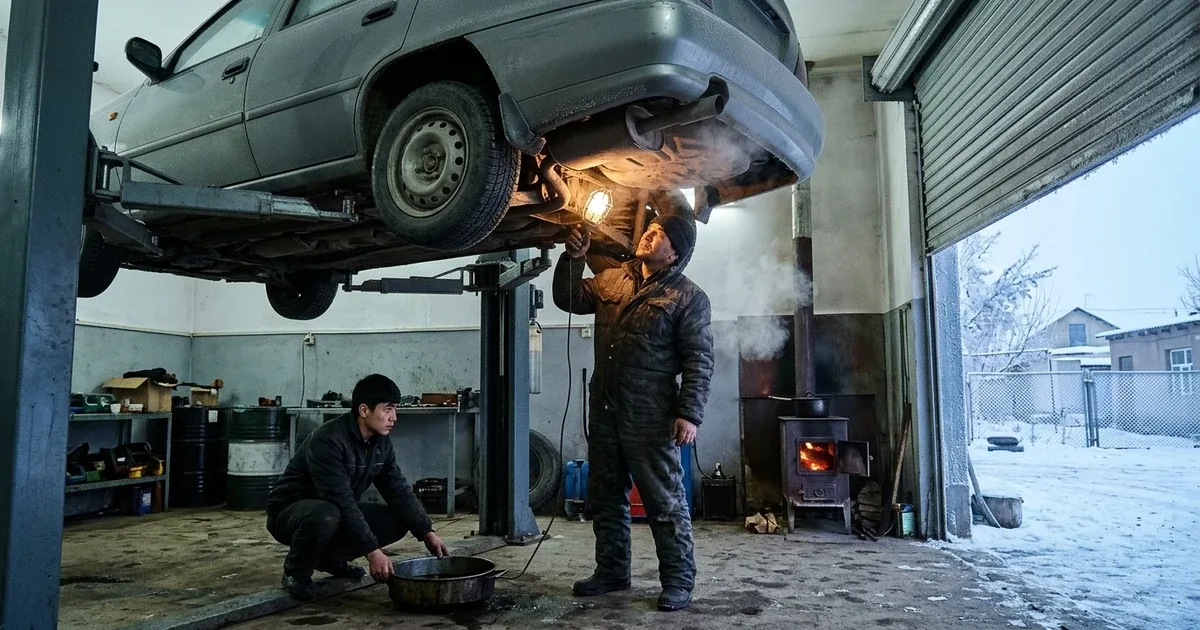
Short answer: car service management software runs a vehicle's whole visit on one repair order, from the moment it enters the gate to the moment the keys go back to the owner. Intake records the VIN, mileage and existing damage. Labour is priced in standard hours, parts are issued from stock against that same order, and mechanic commission is calculated automatically from closed orders. Vehicle history drives the next service reminder, and the owner sees bay utilisation, average ticket and parts margin every day.
Foreign investors, dealer groups and fleet operators who open or acquire a workshop in Uzbekistan often find day-to-day practice far less formal than they expect. Jobs are agreed verbally, an apprentice fetches parts from the market, and prices go into a paper logbook, or nowhere. At month end a mechanic says he did 40 cars; the logbook shows 33. Nobody can prove either number.
Which module to launch first and how to stage the budget is the subject of the guide to ERP for small businesses. This article sticks to what is specific to a workshop: the repair order, labour hours, parts, mechanic commission and vehicle history.
Where the money goes when there are no repair orders
- Unrecorded labour. "The car was already on the lift, so I changed the filter too": the work was done, but the money never reached the till, or went straight to the mechanic.
- Parts issued but not billed. Oil, brake pads or a bulb left the storeroom, but nobody knows for which car.
- Customer disputes. "That scratch wasn't there", "I never agreed to this". If nothing was recorded at intake, the workshop loses.
- Idle lifts. A car waiting two days for a part blocks a bay while another customer drives away.
- Comebacks. A job was done badly and redone for free. Who was responsible and how often it happens is invisible.
The repair order: from intake to handover
The repair order is the workshop's core document: labour, parts, mechanic and payment all attach to it.
Also read Your Customer Calls Twice and Still Has to Spell Their Name: Connecting IP Telephony to ERP in UzbekistanAt intake the service adviser walks around the car with the customer and records:
- VIN and registration number, make, model, year.
- Mileage and fuel level.
- Body damage, photographed on a phone and attached to the order.
- Items left in the car: stereo faceplate, spare wheel, jack.
- The customer's complaint in their own words: "knocking from the right at speed".
The order then moves through statuses: intake → diagnosis → approval → in progress → awaiting parts → ready → handed over. Approval matters most: after diagnosis the customer receives the list of labour and parts with prices, and work starts only once they confirm. If another fault turns up during the job, a separate approval line is opened.

Labour hours and mechanic output
Instead of pricing by eye, build a labour catalogue with a standard time for every operation. Price = standard hours × hourly rate. Complex vehicles or engine types get a multiplier.
Illustrative example (figures only show the logic): the labour rate is UZS 120,000 per hour. Front brake pad replacement is 1.2 hours, UZS 144,000. Wheel alignment is 1.0 hour, UZS 120,000. Both on one order make UZS 264,000 in labour.
Each labour line on the order is assigned to a mechanic; when two share a job, the split is set in percentages. This produces two metrics:
- Bay utilisation = hours sold ÷ available bay hours × 100%. For example, 4 bays × 10 hours × 26 working days = 1,040 bay hours. If 650 hours are sold in a month, utilisation is 62.5%.
- Mechanic efficiency = standard hours closed by the mechanic ÷ hours actually clocked. Below 100% means the mechanic is slower than standard, or his work is not fully reaching the orders.
Parts: stock, special orders and customer-supplied parts
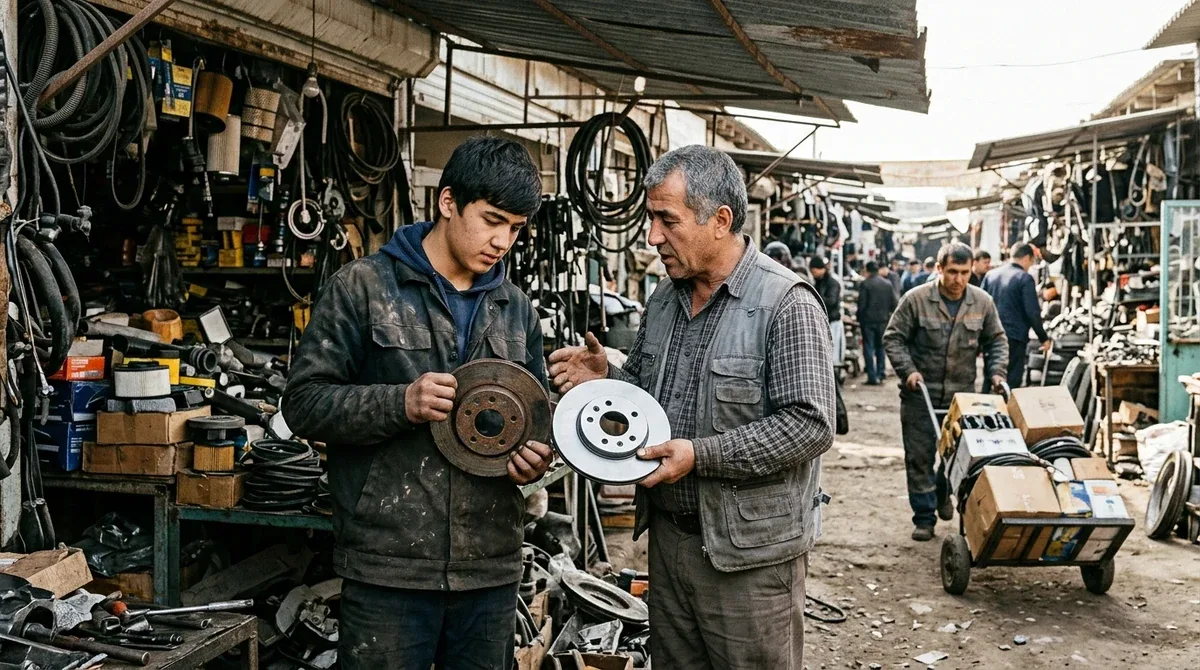
A workshop storeroom is harder to run than a shop's: original and aftermarket versions of the same part, several part numbers, and oil drawn by the litre from a drum. The general rules for receipts, transfers and stock counts are in the article on warehouse inventory automation. A workshop adds its own rules:
- Parts are issued only against an order. Issues for "general use" need approval and a stated reason.
- Cross-references. Aftermarket equivalents are linked to the original part number, so a part already on the shelf is not reordered as "out of stock".
- Special-order parts. Anything not in stock is ordered from the supplier directly from the repair order. On arrival it is reserved for that order and cannot go to another car. For expensive or rare parts, take a deposit, and show it on the order.
- Oils and fluids. Tracked in litres or millilitres. When a drum is opened, its starting volume is recorded; at month end the remainder is measured and reconciled.
- Customer-supplied parts. Zero price, a separate flag and a no-warranty condition.
Write down the parts markup rule too (cost plus a percentage by category), so the adviser never invents prices.
On mandatory digital product marking: auto parts, tyres and motor oils are not on the list yet. The exception is car batteries: under Cabinet of Ministers Resolution No. 662 of 21 October 2025, they have been marked in the Asl Belgisi system since 1 January 2026, and retailers must read the code with a 2D scanner. A workshop that sells batteries needs a scanner at the till and should check for the marking code when stock is received. The list keeps expanding, so watch Tax Committee announcements.
Mechanic commission: a month-end calculation without disputes
In many workshops mechanics earn a percentage of labour. Disputes arise in three places; settle them in writing in advance:
- Base. Labour only, or parts as well. Usually labour, with nothing or a small rate on parts.
- Discounts. If the adviser gives a customer 10% off, is commission calculated before or after the discount?
- Comebacks. When a job is redone under warranty, is the commission for the original job clawed back, and within what period?
Illustrative example: a mechanic closes 180 standard hours in a month, so labour is 180 × UZS 120,000 = UZS 21,600,000. At 35% commission that is UZS 7,560,000. One job that month was redone under warranty; the original labour was UZS 240,000. Under the rule, 240,000 × 35% = UZS 84,000 is deducted. The final payout is UZS 7,476,000.
The system builds this from closed orders, and a mechanic can check his own list at any time. Month end becomes a reconciliation, not an argument.
Customer and vehicle history: VIN, mileage and the next service
The record is opened for the vehicle, keyed by VIN, not for the customer. When the car is sold, the history stays. Every visit stores mileage, work done and parts fitted.
Mileage history lets you forecast the next service. Illustrative example: 62,000 km on 15 March, 70,540 km on 15 July. That is 122 days: 8,540 ÷ 122 = 70 km a day. With an 8,000 km oil-change interval, the next change is due at 78,540 km, roughly 8,000 ÷ 70 ≈ 114 days later, in early November. The system sends an SMS or Telegram reminder a week before. Set intervals by manufacturer guidance and operating conditions.
A reminder is the cheapest way to bring a customer back. How to build repeat visits and loyalty programmes is covered in the article on customer retention.
Payments, receipts and e-invoices
When an individual pays in cash, by card or through a payment app, they receive a receipt from an online cash register or a virtual cash register. Under Presidential Resolution PP-5252 of 4 October 2021, issuing a receipt without an IKPU (MXIK) classification code has been prohibited since 1 January 2022. In practice, the code sits in the labour catalogue and on every part record, and the receipt is built from the order lines automatically. Confirm the correct codes for services with your accountant.
Keep labour and parts on separate lines; receipts, reports and commission depend on it. A deposit is recorded as a separate payment and deducted at final settlement. Automatic matching of Payme, Click and card payments against orders is covered in the article on ERP and payment system integration.
Taxi fleets, logistics firms and company car pools are a separate customer type. They work under contract, often pay later and require an invoice. Under Cabinet of Ministers Resolution No. 522 of 25 June 2019, electronic invoices have been mandatory since 1 January 2020. At month end several orders are combined into one e-invoice; issuing it straight from the system is covered in the article on ERP and e-invoice (ESF) integration. Credit limits and payment terms belong on the fleet customer's record.
Rollout sequence and common mistakes
- Labour catalogue and hourly rate. Start with the 50–80 most frequent operations.
- Opening stock. A full count and clean-up of part numbers and equivalents.
- Repair order and intake report. The adviser works from a phone, with photos.
- Commission rules. Written together with the mechanics and signed.
- Payments, e-invoices and reminders.
Common mistakes:
- Mechanics see the commission rules for the first time on their first payslip, and the resentment turns against the system.
- Issuing parts without an order is allowed "temporarily" and becomes the norm.
- No photos at intake because the customer is a regular.
- The old logbook is kept running in parallel.
Owner metrics and checklist
- Daily — Metric: Open orders, cars awaiting parts, cash, today's handovers
- Weekly — Metric: Bay utilisation, average ticket, work declined at approval
- Monthly — Metric: Hours sold, parts margin, mechanic efficiency, comeback rate, repeat customer share
Average ticket = monthly revenue ÷ closed orders. For example, 312 orders and UZS 249,600,000 in revenue give an average ticket of UZS 800,000.
Checklist:
- ☐ Every car is checked in on a repair order with VIN, mileage and photos.
- ☐ Work starts only after customer approval; extra work is approved separately.
- ☐ Every job is priced from the labour catalogue.
- ☐ Parts leave the storeroom only against an order; special orders are reserved.
- ☐ Commission, discount and warranty rules are written and known to mechanics.
- ☐ Receipts are generated from the order with IKPU codes; fleet customers get e-invoices from the system.
- ☐ Battery sales have the marking code scanned at the till.
- ☐ Service reminders go out automatically from mileage history.
Running a workshop well is not complicated: one order, one rule, one list. Once those three move from paper into a system, the owner talks to mechanics in numbers rather than in arguments.
Frequently asked questions
Does a small two- or three-bay workshop need management software?
With one mechanic, regular customers and parts bought from the market for each job, a well-kept logbook may still be enough. Once two or more mechanics work on commission, parts sit in stock or fleet customers appear, a system pays off quickly: unrecorded labour and missing parts are direct losses.
What should mechanic commission be calculated on?
In many local workshops it is calculated on labour, not on parts, or on parts at a much lower rate. The key is to agree in advance who absorbs a discount: is commission taken before or after it? With one rule in the system, there is no dispute at month end.
How should customer-supplied parts appear on a repair order?
As a separate line, flagged as customer-supplied and priced at zero. Labour is charged as usual. The order should state that the workshop gives no warranty on that part; otherwise, if it fails early, the dispute lands on the workshop.
Is an electronic invoice required for corporate customers?
When invoicing companies, the invoice is issued electronically: under Cabinet of Ministers Resolution No. 522 of 25 June 2019, electronic invoices have been mandatory since 1 January 2020. Confirm the details for your tax regime with a local accountant.
Do auto parts and oils sold by a workshop need digital marking?
Auto parts, tyres and motor oils are not on the mandatory digital marking list yet. The exception is car batteries: since 1 January 2026 they are marked in the Asl Belgisi system, and the code is read with a 2D scanner at the point of sale. The list keeps expanding, so watch Tax Committee announcements.
Opening or acquiring a car service business in Uzbekistan?
Share how repair orders, parts stock, mechanic pay and payments are meant to work, and get a calm, practical view of which part to put into a system first.


