
OSAGO and KASKO are two different kinds of motor insurance. OSAGO is compulsory: it pays for damage you cause to other people in an accident that is your fault, but it does not repair your own car. KASKO is voluntary: it protects your own car against accidents, theft, fire and other risks. Every driver needs OSAGO; whether you need KASKO depends on what your car is worth and what you can afford to lose. Below we explain the difference, who needs what, and how to read a KASKO policy.
OSAGO in brief
OSAGO is compulsory third-party liability insurance for vehicle owners, governed by the Law on Compulsory Civil Liability Insurance of Vehicle Owners (ZRU-155). You may not drive without it.
- Who it pays: the victims — the other car's owner, pedestrians, passengers
- Limit: UZS 80,000,000, of which up to UZS 28 million for property and up to UZS 52 million for life and health
- Price: set by the government and identical at every insurer. For a passenger car, from UZS 160,000 (regions, named drivers) to UZS 384,000 (Tashkent, unlimited drivers)
- What it excludes: the rules explicitly exclude damage the driver causes to the vehicle they are driving
So if you are at fault, OSAGO pays for the other car, and you pay for your own. For the price formula, see the OSAGO calculator.
KASKO in brief
KASKO is voluntary insurance of the car itself. Nobody has to buy it, and, most importantly, each insurer sets its own terms, prices and exclusions. That is why there is no single answer to "how much does KASKO cost".
Ayrıca okuyun OSAGO 2026: the new tariff and how the price is calculatedFor reference, here is what two insurers published on their websites as of November 2026:
- GROSS sug'urta: for a car worth UZS 120,000,000, per year SILVER costs UZS 1,680,000 (1.4%), GOLD UZS 2,400,000 (2%), PLATINUM UZS 3,600,000 (3%)
- Euroasia Insurance: for cars worth up to UZS 500 million, the annual rate ranges from 1.0% (SIMPLE) to 2.2% (DELUXE); for more expensive cars, from 1.2% to 2.5%
These are not market averages, just the public tariffs of two specific companies. Other insurers may price and cover differently. More on the companies: GROSS sug'urta kompaniyasi, Euroasia Insurance.
The key differences
- Obligation: OSAGO is required by law; KASKO is voluntary
- Who is protected: OSAGO protects other people from the consequences of your mistake; KASKO protects your car
- Fault: OSAGO only pays when you are at fault; KASKO usually pays regardless of who caused the damage (depending on the plan)
- Price: OSAGO follows a government tariff; KASKO follows the insurer's tariff, usually a percentage of the car's value
- Terms: OSAGO is defined by law and a government resolution; KASKO by the insurer's rules and offer
- Limit: OSAGO — UZS 80 million; KASKO — the sum insured in the policy, usually the car's market value
One does not replace the other. Even if you buy KASKO, OSAGO is still mandatory.
Example: one accident, two policies
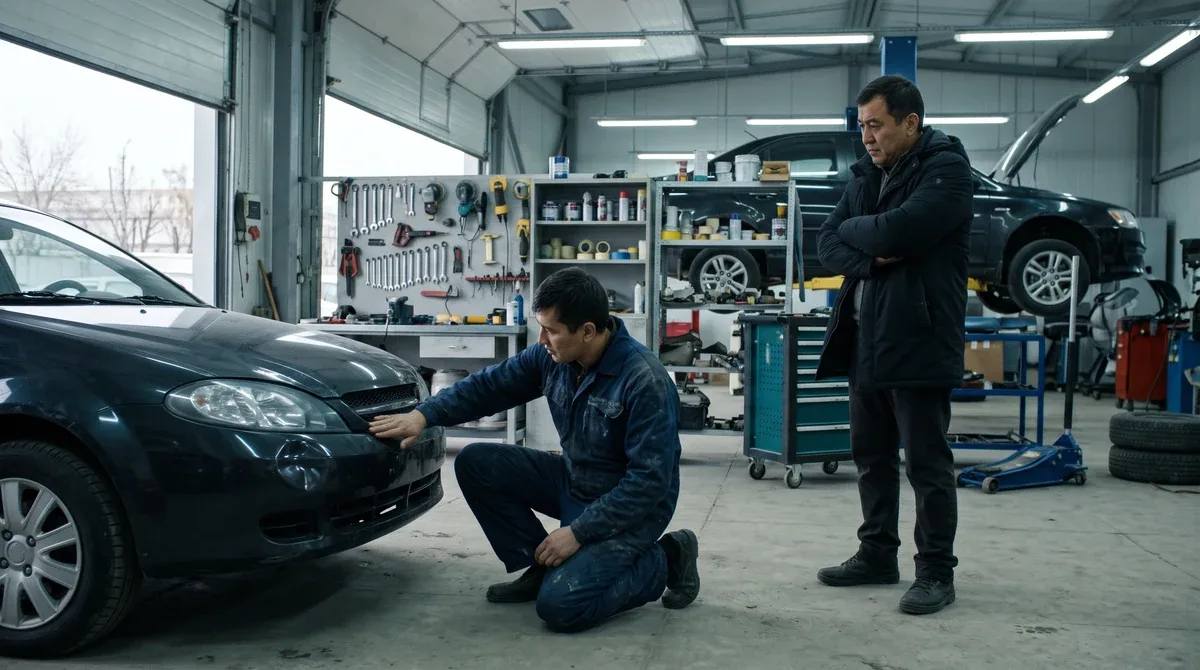
Suppose you cause a collision: the other car suffers UZS 15 million of damage, yours UZS 10 million. Your OSAGO insurer pays the other owner UZS 15 million, since it is within the UZS 28 million property limit. Only KASKO pays for your own car, if that risk is in your plan, minus the deductible. Without KASKO, the UZS 10 million is on you. And if the damage to the other car exceeded UZS 28 million, the amount above the limit would also be yours to pay.
Which one do you need
A new or expensive car
OSAGO is mandatory. KASKO is worth serious consideration: body repairs on a new car, or losing it to theft, can cost many times the annual premium. A comprehensive plan (accident, theft, fire, natural disasters) gives the most protection.
A car bought on credit or leased
Check your loan or lease agreement: it may require KASKO with the bank named as beneficiary. If so, find out which risks must be covered and who chooses the insurer. Even if it is not required, losing the car before the loan is repaid hits your budget twice.
An old or inexpensive car
OSAGO alone is often enough. Compare the annual KASKO price with the car's value and with the repair bill you could handle yourself. Some insurers also offer narrower options: for example, Euroasia Insurance publishes "Euro KASKO" modules for individual parts of the car (windscreen and roof from UZS 200,000, front section UZS 600,000).
A small business fleet
Every vehicle needs OSAGO. If a car off the road means lost revenue, consider KASKO for the key vehicles and check who is allowed to drive under each policy.
How to read a KASKO policy
Read the terms before you look at the price. Pay attention to:
- Covered risks. Cheaper plans may cover road accidents only; theft, fire, natural disasters and unlawful acts of third parties come with more expensive plans.
- Deductible (franshiza). This is the part of each loss you pay yourself, either a fixed amount or a percentage. A higher deductible makes the policy cheaper, but you will fix minor damage at your own cost. Find the exact figure in the policy or offer.
- Exclusions. For example, Euroasia Insurance states that it does not cover natural wear and tear, loss of market value, factory defects, or tyre damage caused by road conditions. Other insurers may have different lists.
- Dealer, garage or cash. Ask where repairs happen: at an official dealer, at a garage chosen by the insurer, or as a cash payout. For a new car this matters especially, as it can affect the manufacturer's warranty.
- Payout without a traffic police report. Some plans allow it for minor damage. For example, Euroasia Insurance allows up to 7% of the sum insured under SMART and up to 10% under DELUXE, once per policy period.
- When cover starts. GROSS sug'urta's SILVER plan starts on day 3 without an inspection; GOLD and PLATINUM start after an inspection.
- Claim notice deadlines. For example, GROSS sug'urta requires a written claim within 5 working days and notes that the European accident report (europrotocol) does not apply to KASKO. Missing a deadline can complicate the payout.
- Sum insured and drivers. Make sure the sum matches the car's real value and check who is allowed to drive.

How to choose an insurer
KASKO prices differ, so compare several insurers, but not on price alone. The service quality rating by the National Agency of Perspective Projects, the insurance regulator, and the share of refused claims show how a company treats payouts. All insurers are listed in the insurance company rating. The rating measures service quality, not financial strength.
Bottom line
OSAGO is compulsory and covers damage you do to others; KASKO is voluntary and covers your own car. For a new, expensive or financed car KASKO usually makes sense; for an old car OSAGO is often enough. When choosing KASKO, read the covered risks, deductible, exclusions and repair method first, and only then compare prices.