
Portfolio /Vitamino: a distributor website that brings in both buyers and manufacturers
Vitamino: a distributor website that brings in both buyers and manufacturers
- Client
- Vitamino
- Region
- 24 Sanoat Street, Yashnobod District, Tashkent
01 Challenge
Client: Vitamino — official distributor of international vitamin and dietary supplement brands in Uzbekistan
Project: corporate website and admin panel — vitaminogroup.com
What we did: analysis and specification, information architecture, design, backend and frontend, SEO, deployment
Stack: Laravel 13, PHP 8.4, Filament 5, Tailwind CSS 4, MySQL
At a glance
- ~7x less to translate: ~200 pages instead of ~1,440
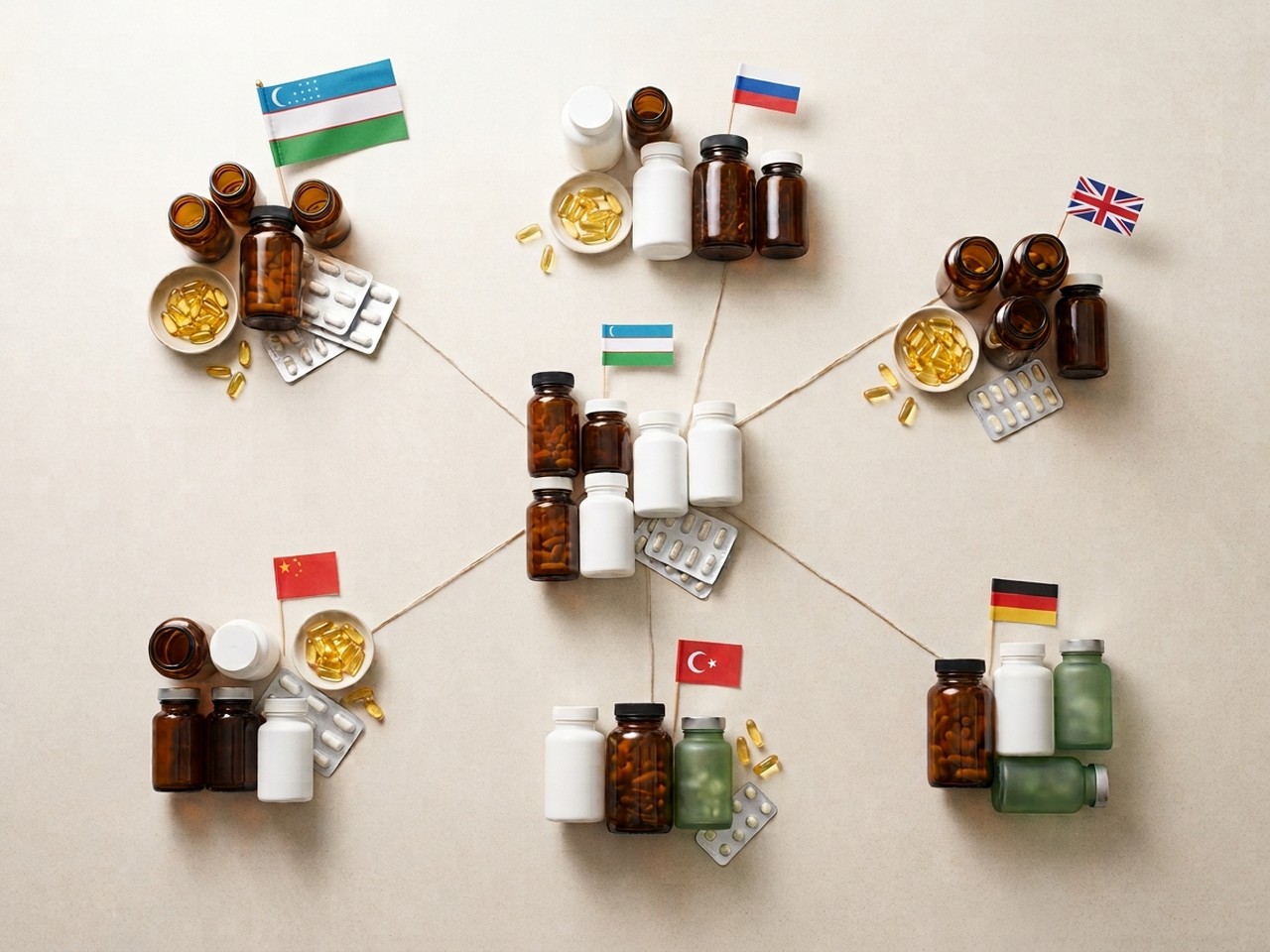
- Live in 6 languages: Uzbek, Russian, English, Chinese, Turkish and German — each with its own address and translated URLs
- 24 brands from 7 countries — each on its own page that can be found in search
- Two audiences, one site: pharmacies and foreign manufacturers
- 25 automated tests guard the SEO rules at code level
The challenge
Vitamino imports vitamin and supplement brands from several countries and supplies them to pharmacy chains across Uzbekistan. For many of these brands, the company is the exclusive representative. A website for this kind of business is opened by two very different people, each looking for an answer to a completely different question:
- A pharmacy or regional distributor (in Uzbek and Russian): "Which brands can I get from you, and on what terms?"
- A foreign manufacturer (in English, Chinese, Turkish, German): "Why should I enter the Uzbek market through you specifically?"
The client's first idea was the usual one — a product catalog. Instead of writing code, we started by testing that idea. As a result, we built the site around four decisions.
1. Brands, not a catalog
A pharmacy buyer doesn't search for "D3 2000 IU capsules" — they type the brand name: "[brand] in Uzbekistan", "[brand] official distributor". On the first query, there's no competing with marketplaces and large pharmacy aggregators. The second gets fewer searches, but there's almost no competition, and it's typed by exactly the person who intends to buy.
That's why the core page of the site is the brand page: country of origin, the year the partnership began, exclusivity, and the list of that brand's products. Products don't get pages of their own. From the home page to a product list takes two clicks.
This decision also settled the translation budget:
- Catalog-based: ~240 product pages → ~1,440 pages across 6 languages
- Brand-based: brands, countries, static pages → ~200 pages across 6 languages
Fields such as product form, dosage and storage temperature are translated once, as a dictionary. Manual translation is only needed for brand descriptions and a handful of static pages.
2. Real multilingual support
The most common mistake on multilingual sites is switching the language with JavaScript inside a single URL. Search engines then mostly see one version, and the other languages barely show up in results. We built it differently:
- Each language has its own address, with translated slugs: the same brand lives at
/uz/brendlar/nordvita,/en/brands/nordvita,/de/marken/nordvitaand/zh/pinpai/nordvita. - The language switcher leads to the translation of the same page, not to the home page.
- Correct hreflang: each page also lists itself, and Chinese uses the correct code
zh-Hans(cnis a country code, and Google ignores such entries). - Canonical always points to its own language.
- The language-less address (
/) reads the browser language and redirects with a 302: choosing a language isn't a permanent move.
3. No translation, no page
Filling six languages at once isn't realistic. Many sites plug the gaps with English or Russian text. Search engines treat this as duplicate, thin content, and it can affect how the whole site is rated.
So every entry (brand, country, page, news item) has a separate "published" flag for each language. A page without a translation returns 404 in that language and is left out of the sitemap, hreflang and the language switcher. The same rule applies to a language as a whole: until it's switched on, none of its addresses exist. This means languages can be switched on one at a time, as soon as the content is ready — no rebuild needed for a new language.
4. Two audiences, one site
The English home page isn't a translation of the Uzbek one. Uzbek and Russian are for buyers; English, Chinese, Turkish and German are for manufacturers. On the first screen, buyers see brands and partnership terms, while manufacturers see the representation offer: registration, logistics, and experience with exclusive contracts.
The "For partners" section is split in two as well. The contact form asks for the request type, and every lead is saved along with the language it came from, so the sales team can pass it straight to the right manager.
02 Result
- A distributor's image: the site presents Vitamino not as just another catalog, but as a trusted representative of international brands
- SEO built for brand-name searches: translated URLs, correct hreflang and canonical tags, structured data
- Live in six languages: each language speaks to its own audience, and the sitemap lists only published pages (354 URLs)
- ~7x lower translation costs compared to the catalog model
- Managed without a developer: admin panel, leads sorted by language and request type
- Protected SEO: 25 automated tests — if someone later changes the code and unknowingly breaks the SEO, a test flags it immediately
Technical details
- Server-side rendering, not an SPA. Laravel Blade + Tailwind CSS 4. Runs even on standard cPanel hosting (no Node.js required) — the safest choice for SEO and mobile speed.
- Speed. Fonts are self-hosted in woff2 with only the required character subsets; no carousel and no render-blocking JavaScript on the first screen.
- SEO foundation. Title and description templates for each page type (editable by a manager), one H1 per page, Schema.org: Organization, BreadcrumbList, Brand, NewsArticle. Product schema is deliberately left out because prices aren't public — so Search Console shows no errors.
- Admin panel (Filament 5). Brands, countries, leadership, history, pages and news; each language in its own field. Requests with statuses (new, in progress, won, lost) and roles: administrator, editor, translator.
- Spam protection without a captcha: IP-based rate limiting and a hidden honeypot field for bots.
- Secure deployment: automatic via cPanel Git; only
public/is exposed to the internet, while.envandvendor/stay closed.
Need a site like this?
If you're a distributor, an importer or a company operating in several markets, a multilingual website is more than a translation. Each language is a separate audience, with its own search queries and its own offer.
We don't start with design — we start by analyzing what your customers search for and in which language. In the first call, we'll work out together which pages will sell for your business, which languages you actually need, and how much you can save on translation.
To discuss your project, click the "Consultation" button or call +998 93 512 53 24.

Let's build your brand together
Leave your number and a specialist will get in touch.
