


Short answer: fitness club software in Uzbekistan has six jobs. It shows how many days or visits a membership has left. It keeps members with expired memberships out at the turnstile. It runs trainer and group class schedules. It reconciles payments with the till and local payment systems. It reminds members before a membership ends. And it shows the owner occupancy and renewal rates.
In a small gym all of this lives with the front desk administrator and a notebook. As the member base grows, the notebook loses money in two places. First, people who keep training on an expired membership. Second, people whose membership ended and who quietly never came back.
For an international franchise opening in Tashkent or Samarkand, the global system usually covers memberships and access. The local layer is what needs attention: payment apps, fiscal receipts, women-only hours and the personal data rules.
How to build a system step by step and split the budget is covered in the guide to ERP for small business. This article deals only with processes specific to gyms, fitness clubs and studios.
What a fitness club loses on paper and spreadsheets
- Entry on goodwill. The membership has ended, the member says "I'll pay tomorrow" and walks in. Tomorrow nobody remembers.
- One membership, two people. A card or code is passed to a friend. Nobody checks faces at the door.
- Vague freezes. "I was ill for a month", and the administrator moves the end date by hand with no rule.
- Empty and overbooked classes. Three people turn up for morning Pilates, while the evening CrossFit class runs out of spots.
- Members who never return. The membership ended, nobody called. A month later they train elsewhere.
Membership types: time-based, visit packs and freezes
In the software a membership is a template with several settings:
Also read Your Customer Calls Twice and Still Has to Spell Their Name: Connecting IP Telephony to ERP in Uzbekistan- Type. Time-based (one month, three months, a year, unlimited). Visit packs (8 or 12 visits within a time limit). Off-peak (mornings or daytime only, at a lower price).
- Zones and services. Gym floor only, or pool and group classes as well.
- Activation. Starting from the first visit rather than the sale date avoids disputes.
- Freeze rule. How many days, how many times, the minimum block. Frozen days are added to the end date automatically.
- Guest visits. Whether the membership includes one or two visits with a friend.
Uzbekistan has its own patterns. Separate women-only hours or a separate women's gym floor. Children's sections, where the parent pays and the child attends. Family memberships, where one payment covers several members. Build each as its own template instead of tracking them in a free-text note. A franchise template from abroad often lacks these, so plan them before launch.
Visit packs and massage or personal training packages work much like session packages in a salon. How to price a session and show the remaining balance is covered in detail in the article on beauty salon software.
Access control: turnstiles, QR codes and face recognition
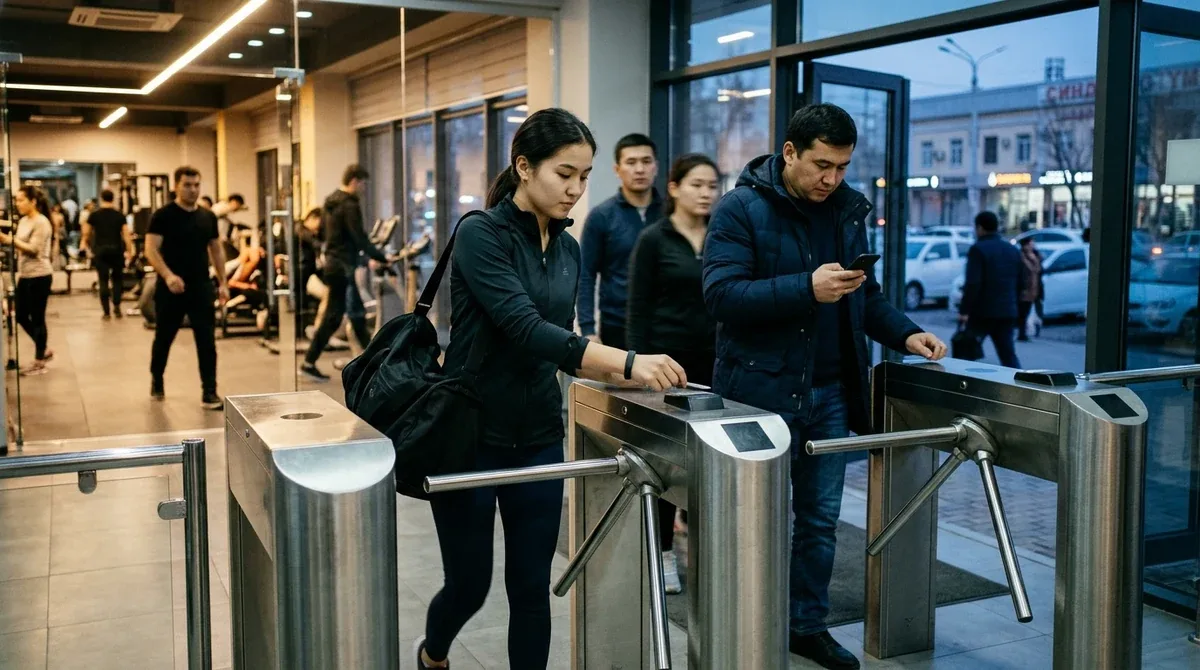
Access control is the backbone of club accounting. The turnstile asks the software a single question: "Can this member come in right now?"
Before answering, the software checks that:
- the membership is active, not frozen and not expired;
- a visit pack still has visits left;
- an off-peak membership allows entry at this hour;
- there is no outstanding debt (if the club has a no-entry-with-debt rule).
Identification methods differ. A plastic card or wristband is the simplest, but it can be handed to someone else. A QR code on the phone is convenient, but it can be shared as a screenshot. Face recognition solves card sharing, but the legal requirements are stricter.
A facial image is biometric data. Uzbekistan's Law on Personal Data (ZRU-547) singles out biometric data: processing it requires the member's consent. After the amendments introduced by Law ZRU-1125, signed on 26 March 2026, biometric data must be stored only on servers inside Uzbekistan. A foreign operator whose global platform keeps member data abroad should check this first. Before switching on face entry, do three things: collect separate consent, confirm where the server is located, and keep card or QR entry for those who decline.
Integrating turnstiles with the software raises two practical questions. What does the turnstile do if the internet drops: let everyone through or lock? Is exit recorded too? If it is, you see in real time how many people are in the club.
Trainer schedules and group classes
A group class is a slot in the timetable: time, studio, trainer and number of places. Members book through an app, a Telegram bot or the front desk. When the class is full, a waiting list opens. If someone cancels, the place is offered to the next person in line.
Three rules keep this in order:
- Cancellation window. For example, two hours before the class. A late cancellation or no-show deducts a visit from the pack.
- Studio capacity. Two classes are never scheduled in the same studio at once.
- Trainer substitution. If a trainer is ill, booked members are notified automatically.
Personal training is sold as separate packages. The trainer's commission is calculated on sessions delivered, not on packages sold. Illustrative example: a package of 10 personal sessions costs UZS 2,500,000, so one session is UZS 250,000. With a 40% trainer commission, each delivered session earns UZS 100,000. Seven sessions in a month means UZS 700,000. The remaining three carry over to next month.
The timetable also gives you occupancy. Illustrative example: 30 classes a week with 15 places each is 450 places. If 315 are booked, occupancy is 315 ÷ 450 = 70%. Cut slots that stay empty and add more of those that fill up.

Payments, fiscal receipts and membership revenue
Members pay in cash, by card at a terminal and through local payment apps such as Payme, Click or Uzum. When the payment reaches the software automatically, the membership activates at once. The administrator does not check receipts by hand. Integration and daily reconciliation are covered in the article on ERP and payment system integration.
When an individual pays, a fiscal receipt is issued through an online cash register or a virtual cash register. Agree with a local accountant how the receipt for a membership sale is formed and which product codes (IKPU/MXIK) apply.
The most common mistake concerns membership money. Payment for an annual membership has not been earned yet. Illustrative example: an annual membership is sold in January for UZS 6,000,000. In management accounts UZS 500,000 is recognised as revenue each month. At the end of January UZS 5,500,000 is a liability to the member. A club that sells many annual memberships in a January promotion and spends the cash on a refit will face a cash gap by summer.
Renewals and member retention
In fitness, acquiring a new member is expensive and renewing an existing one is cheaper. So renewal should be a distinct process in the software.
- Reminder before expiry. For example, an SMS or Telegram message 7 and 2 days before. Setting up the messages is covered in the article on SMS and email marketing.
- "Fading" members. Someone who came three times a week has not shown up for two weeks. The software lists them and a trainer calls.
- Renewal offer. Members who renew early get extra freeze days or a personal session.
- Reason for leaving. Those who do not renew get one question: why? The answers are reviewed monthly.
Renewal rate = members who renewed this month ÷ memberships that ended this month. Illustrative example: 120 memberships ended and 78 were renewed: 78 ÷ 120 = 65%. Building a loyalty programme and repeat sales is covered in the article on customer retention.
Numbers the club owner should track
- Daily — What to review: Entries, occupancy by hour, till, denied entries
- Weekly — What to review: Group class occupancy, no-shows, "fading" members
- Monthly — What to review: Active members, new sales, renewal rate, revenue and commission by trainer, membership liability
Member lifetime value (LTV) can be estimated as average monthly payment × average number of months a member stays. Illustrative example: UZS 500,000 × 8 months = UZS 4,000,000. Acquiring one member through advertising should cost well below that.
Implementation steps and common mistakes
Split implementation into four stages:
- Data collection. All active members, end dates and remaining balances. Verify doubtful records with the member directly.
- Membership templates and rules. Freezes, cancellations, guest visits, all in writing.
- Till and payments. Every payment in the software is linked to a membership.
- Turnstiles and reminders. Access control goes live last, once the data is clean.
Common mistakes:
- Migrating the old database without checking it. On day one the turnstile locks out real members.
- Letting administrators change any end date by hand. Every change should be logged with a reason.
- Launching the timetable without training the trainers. They go back to taking bookings in Telegram.
- Buying a complex system for a single gym. Start with memberships, till and reminders, then add the rest.
Checklist: are the club's records in order
- ☐ Every membership type exists in the software as a template.
- ☐ The freeze rule is written down and calculated automatically.
- ☐ A member with an expired membership cannot pass the turnstile.
- ☐ Group classes have a place limit and a waiting list.
- ☐ Trainer commission is based on sessions delivered.
- ☐ Every payment is linked to a membership and a receipt is issued.
- ☐ A reminder before expiry goes out automatically.
- ☐ Separate consent is collected for biometric entry.
If five of the eight answers are "no", start with membership templates and the till. Turnstiles and the app come in the second stage.
Frequently asked questions
Do we need software for one gym with two trainers?
While members number a few dozen and the front desk knows each of them, a logbook and a spreadsheet are enough. Once there are several membership types, freeze requests, trainers paid on commission or more members than anyone can remember, manual records quickly fall apart.
Should members be allowed to freeze a membership?
Many clubs allow it, because a member who stops for illness or travel tends to come back. What matters is a written rule: how many days, how many times, the minimum block and who approves. The software adds frozen days to the end date automatically.
What should we check before launching face recognition entry?
A facial image is biometric data. It requires the member's separate, verifiable consent, and the data must be stored in Uzbekistan. Keep card, wristband or QR entry for members who do not consent. Review the requirements with a local lawyer before installation.
Is an annual membership payment revenue for the month it is paid?
Not in management accounts. An annual membership is recognised as revenue as the service is delivered, month by month. The rest is a liability to the member. Agree with a local accountant how it is treated for tax purposes.
Shall we review your club's processes together?
We will look at how memberships, entry, trainer schedules and payments are handled today and suggest which part is worth moving into a system first.


