


Short answer: an SOP is a written rule for how a piece of work gets done. A good one fits on one or two pages: the purpose, the owner, the steps, the deadline and how the result is checked. You do not need to document everything at once. Start with three to five processes that repeat often and where mistakes are expensive. The person who does the work writes the draft, a manager reviews it, and a newcomer tests it. For a foreign company building a team in Uzbekistan, written procedures are also how head-office standards survive contact with local reality.
Regulations, SOPs and job descriptions: what is the difference
In many companies, knowledge lives in people's heads. An experienced sales manager knows how to process an order, but it is written down nowhere. When that person goes on leave or resigns, the process stalls, and every new hire takes their questions straight to the owner or country manager.
Three kinds of documents solve this, and it helps to keep them apart:
- Job description: what an employee is responsible for. It is about the role.
- Process regulation: the order in which a process runs: who starts it, who approves, within what time. It is a rule between several roles.
- SOP (standard operating procedure): a step-by-step instruction for one task. It is the document that sits within reach at the workstation.
In a small operation, the regulation and the SOP can share one page. The label matters less than whether the document is used.
Why does this matter to an owner? A documented process is the precondition for handing operations to someone else. Whether you appoint a hired general manager or work with a local operator under a partner-manager model who shares in the results, you can only hand over control once the rules are on paper. Otherwise the new manager learns everything from scratch or calls you about every decision. SOPs are one part of a wider effort and are usually written during business systematization, once roles are defined.
Which processes to document first
The most common mistake is trying to document everything at once. Forty documents appear in a month, and none of them is used. A simple matrix is enough to choose.
Also read Product Certification in Uzbekistan: Which Goods Need What, Recognition of Foreign Certificates and Digital MarkingAsk two questions about each process:
- How often does it repeat? Daily, weekly or monthly.
- How expensive is a mistake? Lost money, a lost customer or just an inconvenience.
- Repeats often — Costly mistake: Document first; Cheap mistake: A short checklist is enough
- Repeats rarely — Costly mistake: Document in detail, later; Cheap mistake: Leave it for now
The first group usually includes taking and processing customer orders, collecting payment, receiving and shipping goods, handling returns and complaints, and closing the cash register at the end of the day.
There is one more useful signal. Which questions does the owner or country manager answer several times a day? For one week, write down every question staff bring to you. A repeated question is an unwritten SOP.
SOP template: eight sections on one page
When every SOP follows the same structure, people read it quickly and find the right spot immediately. This template fits most businesses:
- Title and version — What goes in it: Process name, version number, date; Example: Taking a customer order, v1.2
- Purpose — What goes in it: One sentence: why this process exists; Example: The order reaches the warehouse error-free within 2 hours
- Scope — What goes in it: Where it starts and where it ends; Example: From the customer's request to handover to the warehouse
- Owner — What goes in it: Who performs it, who approves; Example: Sales manager; approved by senior sales manager
- Inputs — What goes in it: What is needed to start; Example: Customer name, phone number, list of items
- Steps — What goes in it: Numbered, one action per step; Example: 1. Look up the customer in the database…
- Result and check — What goes in it: How you know it was done right; Example: Order shows status "Sent to warehouse" in the system
- Exceptions — What goes in it: What to do in non-standard cases; Example: Item out of stock: escalate to senior manager
The most important of the eight is "Result and check". Without it, an SOP is just a description. If the result cannot be checked, nobody can manage the process.
How to write an SOP in seven steps
- Pick the process and set its boundaries. One sentence on where it starts and where it ends.
- Talk to the person who does the work. Let them explain or show it. You take notes and keep asking, "What happens next?"
- Write the steps. Each one starts with a verb: "check", "enter", "send". One action per step.
- Mark the decision points. Flag places like "if the payment has not arrived…" separately. Most errors happen here.
- Test it on a newcomer. Hand the document to someone who does not know the process and let them do the work from the text alone. Wherever they get stuck, the writing is unclear.
- Fix and approve. A manager reviews the text; the owner checks only the rules that involve money and customers.
- Publish and train. Put the document where everyone can find it and walk the team through it in a short 15-minute session.
Do not skip step two. Head office writes how things should work; local staff know how they actually work. The gap between the two often points to the most expensive problems.
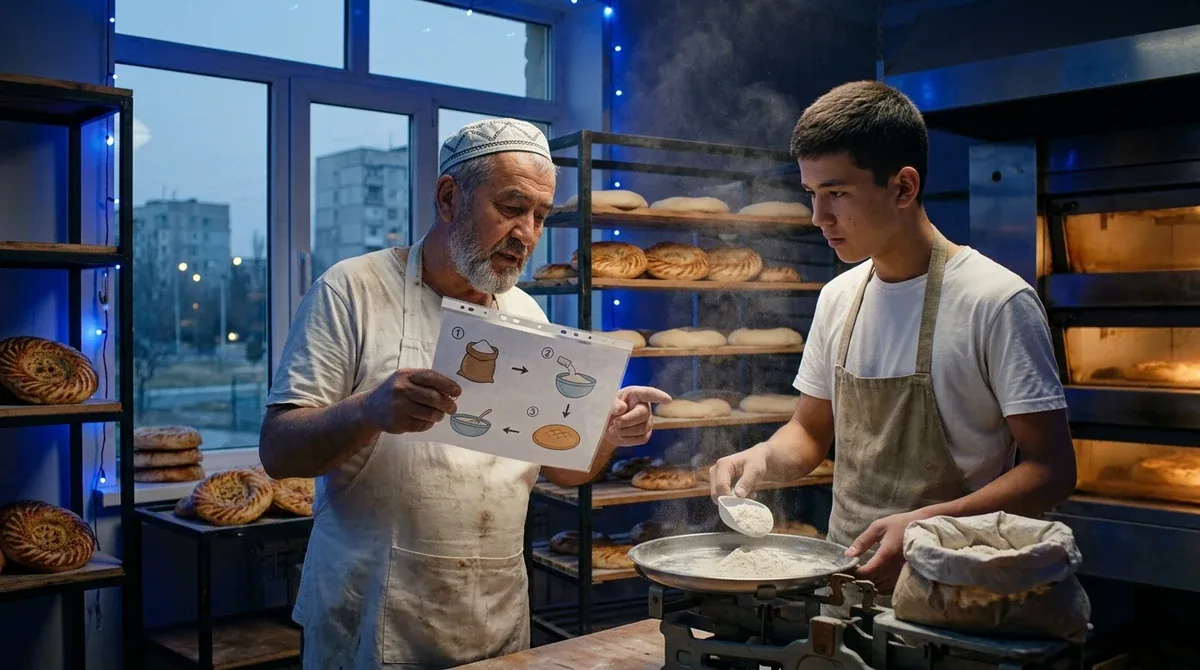
Sample SOP: "Taking a customer order"
Below is a short SOP for a wholesale distributor. Adapt it to your own process.
Purpose: the order is processed without errors and handed to the warehouse within 2 hours. Owner: sales manager. Approved by: senior sales manager.
- Look up the customer by phone number. If not found, create a new customer card.
- Read the list of items back to the customer, line by line.
- Check stock in the system. If something is short, offer a substitute or a later date.
- Apply the price and discount from the price list. Any discount above the list requires the senior manager's approval.
- Confirm payment terms: prepayment or deferred payment. Deferred payment only for customers on the approved list.
- Record the delivery address and time window.
- Move the order to the status "Sent to warehouse".
- Send the customer the order number and expected delivery time.
Check: at the end of each day, the senior manager reviews orders still in "New" status. Exception: if the customer changes the order before step 7, the manager edits it; after step 7, the change is agreed with the warehouse.
Notice that the sample contains no vague words. Not "be attentive to the customer", but "read the list back". Every step can be verified.
What makes SOPs actually work
A written document is not yet a system. To keep procedures from gathering dust in a folder, you need four things.
Build them into onboarding. Every new hire reads the SOPs for their role in the first week and performs them next to a mentor. This shortens ramp-up time and spares managers from explaining the same thing again and again.
Set a control point. Each SOP states how the result is checked, and the manager looks at that point regularly. That way you do not have to watch every step once a task is handed over. The article on delegation for business owners covers this in more detail.
Link them to metrics. The output of key processes can be measured: share of orders with errors, shipping time, number of returns. These numbers later become the basis of an employee KPI system.
Review them regularly. When the process changes, the document changes. Every SOP has an owner, the responsible manager, who reviews it once a quarter. An employee who spots an error or an outdated step should feel free to say so.
If you plan to introduce an accounting system or ERP later, written procedures help a great deal. Developers and the implementation team do not have to guess how the process works; they take it from a ready document. This is the analysis stage described in the article on ERP implementation stages.

Common mistakes
- Documenting everything at once. Fifty documents in two months, forgotten by month three. Write and roll out three to five processes per month.
- Writing in the owner's office or at head office. An SOP written without the people who do the work does not match reality, and staff will not accept it.
- Vague wording. "High quality", "on time", "carefully" cannot be checked. Write a specific action and a specific deadline.
- Documents that are too long. Nobody opens a ten-page procedure during the working day. Split long processes into several short SOPs.
- Rollout without follow-up. The document exists, but nobody checks results. A month later everyone works the old way.
- Exceptions from the top. If the person who wrote the rule breaks it, the team will too.
Self-check: a 10-question test
Give yourself one point for every "yes".
- Are your five most frequent processes documented in writing?
- Does each document name an owner?
- Does each SOP state how the result is checked?
- Are the documents stored in one place where everyone can find them?
- Do the documents carry a version number and a date?
- Does a new hire read the SOPs for their role in the first week?
- Did the people who do the work take part in writing the SOPs?
- Has at least one document been updated in the last three months?
- If you were away for two weeks, would ordering and payment keep running?
- Does your team avoid asking you the same question several times a week?
8–10 points: the foundation is there; now link processes to metrics. 4–7 points: some documents exist, but they are not yet a management tool. Start with control points. 0–3 points: knowledge still lives in people's heads. Use the matrix to pick the first three processes and document them this month.
Bottom line
An SOP is not a thick binder but a short instruction that sits within reach at the workplace. Start with processes that repeat often and where mistakes are costly. Use one template, and give every document a clear way to check the result. Write it with the people who do the work, in their working language, and test it on a newcomer. Then processes keep running without the owner in the room, new staff ramp up faster, and handing over operations becomes a realistic plan.
Frequently asked questions
Is there a difference between a process regulation and an SOP?
In practice the terms are often used interchangeably. A process regulation usually sets the overall rules: who does what, when and within which deadline. An SOP is a step-by-step instruction for one task. In a small operation both can live in a single one- or two-page document.
Who should write the SOPs?
The first draft is best written by the person who does the work every day, because they know where things go wrong. A manager reviews and approves it. If the owner or head office writes every procedure alone, the work slows down and the document drifts away from how things really happen locally.
What language should SOPs be in for a team in Uzbekistan?
Keep a master version in your corporate language, but give staff a version in their working language, usually Uzbek or Russian. A procedure people cannot read without help will not be followed at the desk or in the warehouse.
Where should SOPs be stored?
In one place everyone can reach in a click: a shared folder, an internal knowledge base or the system the team already works in. Each document should show a version number and the date of its last update, with old versions moved to an archive.
Want to document your core processes in Uzbekistan?
Let's look at which processes still depend on one or two people, then calmly plan the first set of SOPs and how to roll them out to the local team.
Discuss your SOPs →


